Milk River Watershed – EIS
Milk River Plan-EIS Overview
The Milk River Joint Board of Control (MRJBOC) received funds from the Natural Resources Conservation Service (NRCS) Montana State Office through NRCS’ Watershed Protection and Flood Prevention Act Public Law 83-566 Small Watershed Program. These funds are being used to develop a Watershed Plan-Environmental Impact Statement (Plan-EIS) that proposes to modernize the St. Mary Canal System to improve the reliability and capacity of St. Mary River water deliveries and reduce damages to irrigated agriculture and agricultural communities served by the Milk River Project. The Plan-EIS project includes reshaping the St. Mary Canal prism; modifying siphons, updating drop structures, wasteways/drains, and underdrains (culverts); mitigating slides; and improving the operation and maintenance (O&M) roads. These measures would improve water delivery reliability, decrease agricultural damages to Milk River Project irrigators, and mitigate the risk of infrastructure failure. If the Plan-EIS is authorized, MRJBOC could be eligible for additional technical assistance and construction funds.
During this process, NRCS is the lead federal agency. A Draft Plan-EIS has been developed in cooperation with the Bureau of Reclamation and the Montana Department of Natural Resources and Conservation, and in participation with the Blackfeet Tribal Business Council.
This watershed planning process began in the summer of 2023 when a scoping period and public meetings were held. Feedback that was provided during that period was used to develop a preliminary Draft Plan-EIS that underwent multiple technical reviews by NRCS. The Draft Plan–EIS is now ready for review as part of a public comment period from February 13, 2026, through March 30, 2026. As part of this comment period, public meetings will be held in Havre, Browning, and Malta, Montana (information on meetings below). Following the public comment period, project partners will review comments, incorporate or address public comments, and finalize the Plan–EIS, including a record of responses to comments.
What is an Environmental Impact Statement (EIS)?
The purpose of this Draft Plan-EIS is to plan and evaluate actions which alleviate damage to irrigated agriculture and agricultural communities served by the Milk River Project. The proposed project would increase canal capacity to deliver the full allocation of the St. Mary River water right to Milk River Project beneficiaries. The Draft Plan-EIS includes a description of different alternatives, including two action alternatives and a no action alternative, and evaluates the effects of these alternatives on a variety of resources.
Alternatives Considered
During the formulation process, the Draft Plan-EIS initially developed a range of alternatives, of which three were selected for more detailed analysis. These three alternatives included:
Alternative 1—No Action Alternative: Under the No Action Alternative, federal funding through PL 83-566 would not be available to implement the project. MRJBOC would continue to operate and maintain the existing system in its current condition.
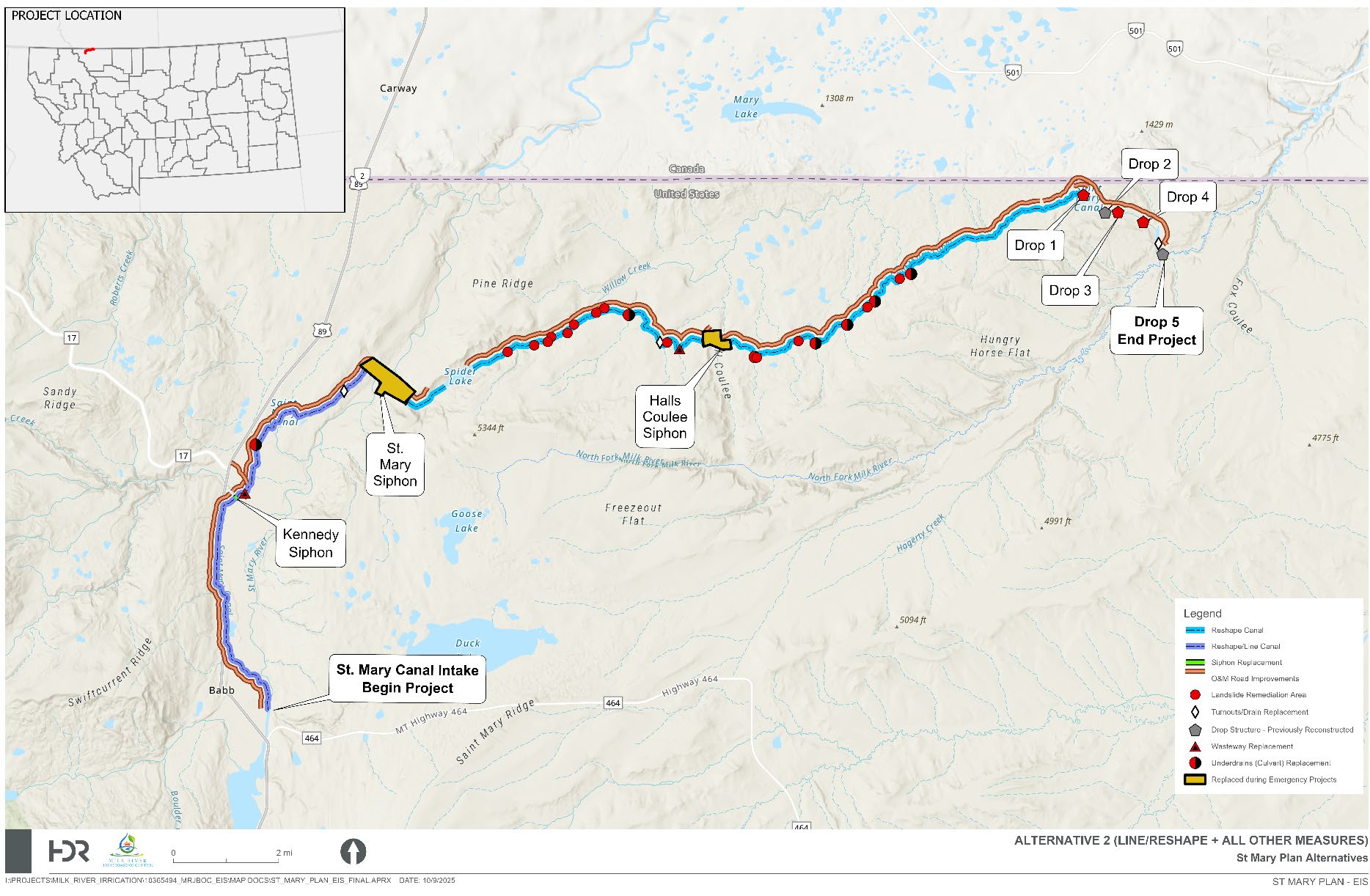
Alternative 2—Canal Modernization, Line/Reshape: Alternative 2 would include lining of the first 9 miles of the canal; reshaping the remainder of the canal; upgrading a siphon, drop structures, wasteways/drains, and underdrains (culverts); mitigating slides; and improving the O&M roads.
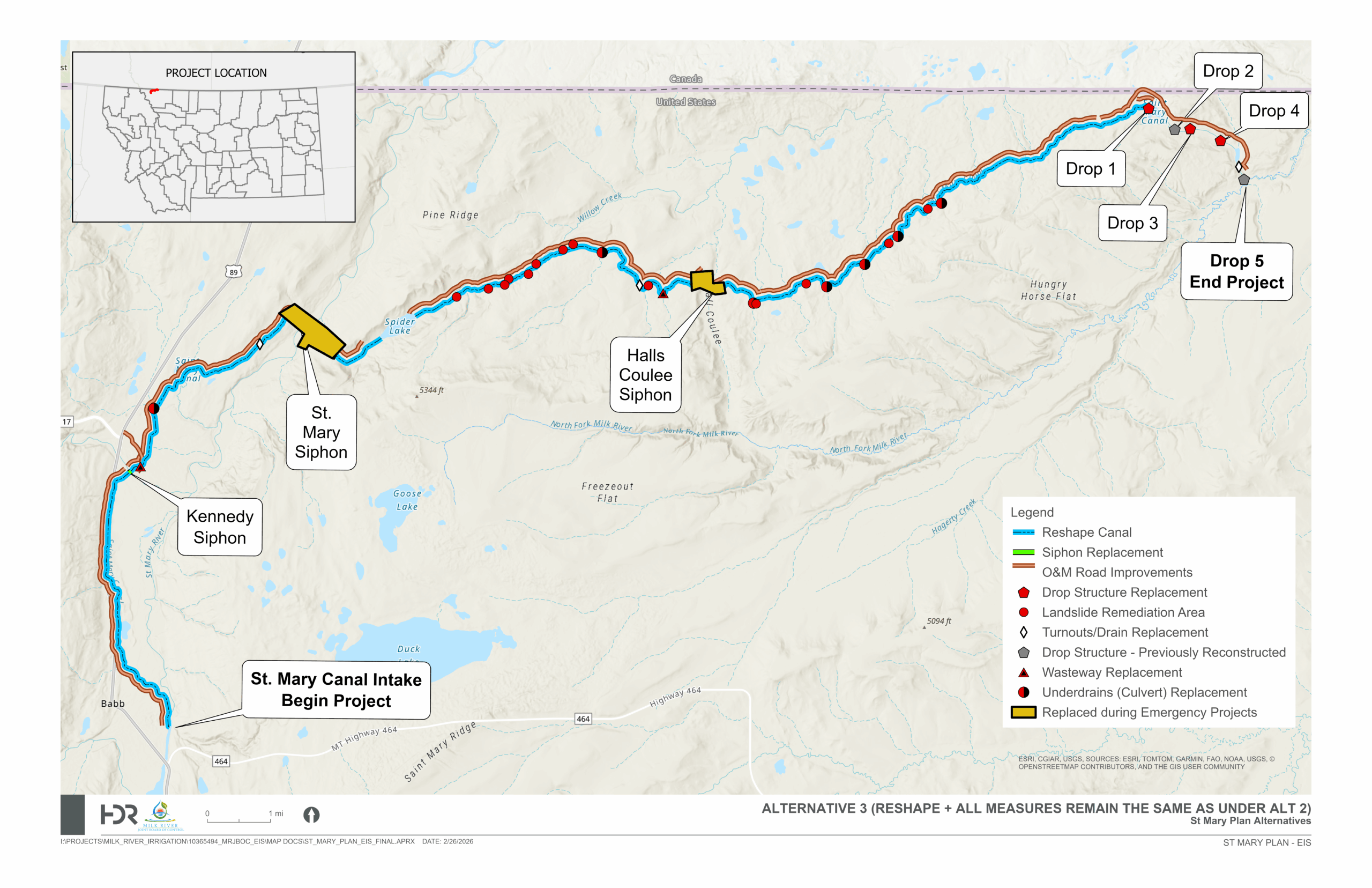
Alternative 3 – Canal Modernization, Reshape: Alternative 3 would include reshaping the canal; upgrading a siphon, drop structures, wasteways/drains, and underdrains (culverts); mitigating slides; and improving the O&M roads.
Resources Analyzed
The Draft Plan-EIS assesses the effects of the three alternatives on a variety of resources including the following:
1. Water Resources: Analysis of the risk of infrastructure failure and water conveyance capacity, as well as effects to water quality, groundwater, and surface water.
2. Environmental and Ecological Resources: Consideration of the impacts on aquatic and terrestrial habitats, wetlands, and threatened species like bull trout and grizzly bears.
3. Cultural and Historic Resources: Consideration of the potential effects on cultural resources, with stipulations in place for mitigation during construction, particularly in consultation with the Blackfeet Tribe and stakeholders.
4. Socioeconomic Factors: Assessment of economic impacts, including effects to agricultural production and employment.
5. Ecosystem Services: Consideration of the potential effects to ecosystem services.
Draft Watershed Plan-Environmental Impact Statement Proposed Preferred Alternative
The Draft Plan-EIS proposes Alternative 3 as the Preferred Alternative. Alternative 3 was selected for its alignment with Federal Objectives and Guiding Principles, and because it offers the best environmental social and economic benefits. This alternative This alternative would increase the capacity of the St. Mary Canal System to 850 cubic feet per second (cfs) and improve its reliability by addressing concerns with the aging infrastructure, including the canal, siphon, wasteways, underdrains, and drop structures.
Under Alternative 3, the entire 29–miles of the canal would be reshaped. Reshaping includes improvement of the existing embankment to establish the minimum required freeboard (distance from the channel’s maximum water level to the top of the bank) in the canal and construction of a new embankment on the “uphill” side of the canal. At the Kennedy Creek Crossing Siphon, a new additional reinforced concrete box would be installed adjacent to the existing siphon, and the existing siphon would remain in place and be rehabilitated. Three drop structures would be replaced. Slope stabilization or slide mitigation, would occur at 13 areas that are at risk of slope failure due to poorly consolidated glacial sediment, over-steepened slopes and banks, and/or fluctuations in groundwater conditions due to canal operations and precipitation. The underdrains would be replaced and upsized by 6 inches at the existing locations. The wasteways would be replaced at the existing locations, and sizing would be reviewed during final design and increased if needed. Drains would be replaced at existing locations and at existing sizes. The drains would be modernized to include manual gate opening release and passive overflow level control mechanisms. The maintenance road would be widened to allow for more reliable access for operations and maintenance of the St. Mary Canal System.
News & Updates
Draft Watershed Plan-Environmental Impact Statement
Notice of Intent (NOI) Federal Register Publication Announcement
NOI Formal Scoping Period Begins June 21, 2023 and Closes August 7, 2023
Public Meetings set on next phase of St. Mary Diversion Rehabilitation
Upcoming Public Meetings
Havre Public Meeting
March 3, 2026
11:30 – 12:30 p.m.
Best Western Plus Great Northern Inn
1345 1st Street, Havre, MT 59501
Malta Public Meeting
March 3, 2026
4:30 – 5:30 p.m.
Great Northern Hotel
2 S 1st Street E, Malta, MT 59538
Browning Public Meeting*
March 4, 2026
12:00 – 1:00 p.m.
Glacier Peaks Hotel & Casino
50 Museum Loop, Browning, MT 59417
Video of Initial Public Scoping Presentation
How to Comment
On February 13, 2026, NRCS announced a public comment period to present the Draft Plan-EIS. Public comment will be formally accepted from February 13, 2026, through March 30, 2026.
Public comments that will be formally considered as part of the project record must be submitted from February 13, 2026, through March 30, 2026. Comments may be emailed to milkriver.project.comments@gmail.com, submitted online at www.milkriverproject.com/projects/watershed, left as a voice message at (406) 587-6712, or mailed to: USDA NRCS, Alyssa Fellow, Environmental Compliance Biologist, 10 East Babcock Street, Room 443, Bozeman, MT 59715. Additionally, a Public Comment Form is available on the project website.
Public Scoping Online Email Comment Form
Please note: Before including your address, phone number, email address, or other personal identifying information in your comment, be advised that your entire comment—including your personal identifying information—may be made publicly available at any time. While you can ask us in your comment to withhold your personal identifying information from public review, we cannot guarantee that we will be able to do so. Further information on the public involvement process can be found on the Council for Environmental Quality’s Citizens Guide to NEPA website.
Schedule
What happens after the Final Watershed Plan-Environmental Impact Statement is published?
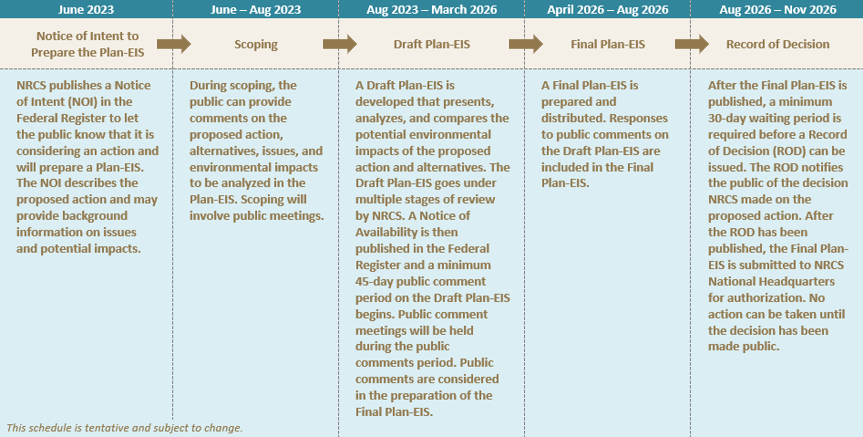
After a Final Plan-EIS is published, a minimum 30-day waiting period is required before a Record of Decision (ROD) may be issued. The ROD notifies the public of the decision NRCS made on the proposed action. After the ROD is published, the Final Plan-EIS is submitted to NRCS National Headquarters for authorization.
What is the purpose of the Watershed Plan-Environmental Impact Statement for the Milk River and St. Mary River Watersheds?
The purpose of this watershed plan is to alleviate damages to irrigated agriculture and agricultural communities served by the Milk River Project by increasing access to St. Mary River water. The project is needed to deliver the fully allocated St. Mary River water right to Milk River Project beneficiaries to minimize agricultural damages and address the unreliable access to St. Mary River water.
What are the overall benefits of the project?
Potential benefits of the St. Mary Canal Modernization Project include increased reliability of water delivery for Milk River Project users, including eight irrigation districts, the Blackfeet Nation, numerous private irrigators, several municipalities, and the Bowdoin National Wildlife Refuge; improved drought resilience; and reduced risk of infrastructure failure that could cause environmental damage on the Blackfeet Indian Reservation, the St. Mary River, and the North Fork Milk River.
When does the public get to review and comment on the Draft Plan-EIS?
The NOI formal scoping period begins on June 21, 2023, and closes August 7, 2023, during which time the public has a chance to submit comments to be considered in the drafting of the Plan-EIS. After the scoping period, information gathered during this period will inform the writing of the Draft Plan-EIS. The Draft Plan-EIS will then be published for public review and comment, and an additional public meeting will be held which is estimated to occur during the Fall of 2024.
What is the role of Farmers Conservation Alliance (FCA) and HDR?
FCA and HDR are leading the consulting services in support of the St. Mary Canal Modernization Project under National Resources Conservation Service (NRCS), Milk River Joint Board of Control (MRJBOC), and Bureau of Reclamation’s oversight. They are responsible for preparing a Plan-EIS pursuant to the National Environmental Policy Act (NEPA) and the Principles, Requirements, and Guidelines for Water and Land Related Resources Implementation Studies (PR&G) to assess the potential environmental impacts from modernization of the St. Mary Canal and its associated infrastructure.
How can I submit comments?
Submitting comments is the most effective way to make your voice heard in the EIS process. Please feel free to send comments at any time during the process.
Comments may be:
- Emailed to milkriver.project.comments@gmail.com
- Submitted online at http://milk-river-irrigation.local/projects/watershed via a comment form (linked here)
- Submitted via phone to USDA NRCS, Alyssa Fellow, Environmental Compliance Specialist, at (406) 587–6712
- Mailed to USDA NRCS, Alyssa Fellow, Environmental Compliance Specialist, Attn: St. Mary Canal Modernization Project, 10 East Babcock Street, Room 443, Bozeman, MT 59715
- A printed copy is available by contacting Paul Smidansky, NRCS Design Engineer, at 406-587-6827 or Paul.Smidansky@USDA.gov.
What is the role of the National Resources Conservation Service (NRCS) and the Bureau of Reclamation for the proposed project?
The NRCS Montana State Office is funding the development of the Plan-EIS for the St. Mary Canal Modernization Project. The Bureau of Reclamation is the water right holder and owner of portions of the Milk River Project infrastructure, including the St. Mary Canal and associated infrastructure considered for the modernization project. NRCS is the lead federal agency and Bureau of Reclamation will be a cooperating agency during the Plan-EIS process.
What are the Principles, Requirements, and Guidelines for Water and Land Related Resources Implementation Studies (PR&G)?
The PR&G govern how federal agencies evaluate proposed water resource development projects. They provide direction to federal agencies when evaluating and selecting major water projects. As it relates to the St. Mary Canal Modernization Project, in addition to complying with the requirements of National Environmental Policy Act (NEPA), the Plan-EIS must also meet PR&G requirements. More information on how the PR&G will be incorporated into the Plan-EIS process can be found in the U.S. Department of Agriculture’s Guidance for Conducting Analyses Under the Principles, Requirements, and Guidelines for Water and Land Related Resources Implementation Studies and Federal Water Resource Investments DM 9500-0013.
What is the National Environmental Policy Act (NEPA)?
NEPA was the first major environmental law in the United States, signed by President Nixon on January 1, 1970. NEPA requires federal agencies to assess the environmental effects of their proposed actions prior to making decisions. The goal of the NEPA process is to foster action that protects, restores, and enhances our environment. This is achieved through using Environmental Assessments (EAs) and Environmental Impact Statements (EISs) to provide public officials with relevant information and allow a detailed look at the potential environmental consequences of each proposed project. Read more about the NEPA process from the Council of Environmental Quality.
What is a Watershed Plan – Environmental Impact Statement (Plan-EIS)?
A Plan-EIS is an official environmental review document required by the Natural Resources Conservation Service (NRCS) for planning and carrying out projects under the Watershed Protection and Flood Prevention Program (also known as Public Law 83-566) and to comply with the National Environmental Policy Act (NEPA). A Plan-EIS is required for any project that applies for federal financial assistance through the NRCS Watershed Program and anticipates that the proposed project could significantly affect the quality of the human and natural environment.
What is the purpose of the St. Mary Canal Modernization Project?
The purpose of the proposed project is to improve agricultural water management by rehabilitating and modernizing the St. Mary Canal along its existing alignment. The proposed project is needed due to existing system inadequacies, as well as the risk of infrastructure failure. The current system inadequacies have reduced the reliability of water delivery to water users who rely on the St. Mary Canal for agricultural, municipal, residential, industrial, and recreational uses. Failure could lead to environmental damage on the Blackfeet Indian Reservation, the St. Mary River, and the North Fork Milk River.
How is this project going to affect my property?
All project activities will take place along the existing St. Mary Canal alignment. The Milk River Joint Board of Control (MRJBOC), Natural Resources Conservation Service (NRCS), and the Bureau of Reclamation are committed to working with property owners along the St. Mary Canal alignment to address concerns. To learn how your property might be impacted by the St. Mary Canal Modernization Project, please contact USDA NRCS, Alyssa Fellow, Environmental Compliance Specialist, at (406) 587–6712.
Where is the St. Mary Canal Modernization Project located?
The project is located in Glacier County, Montana, and lies completely within the Blackfeet Indian Reservation.